

The Evolving Cyber Threat Landscape
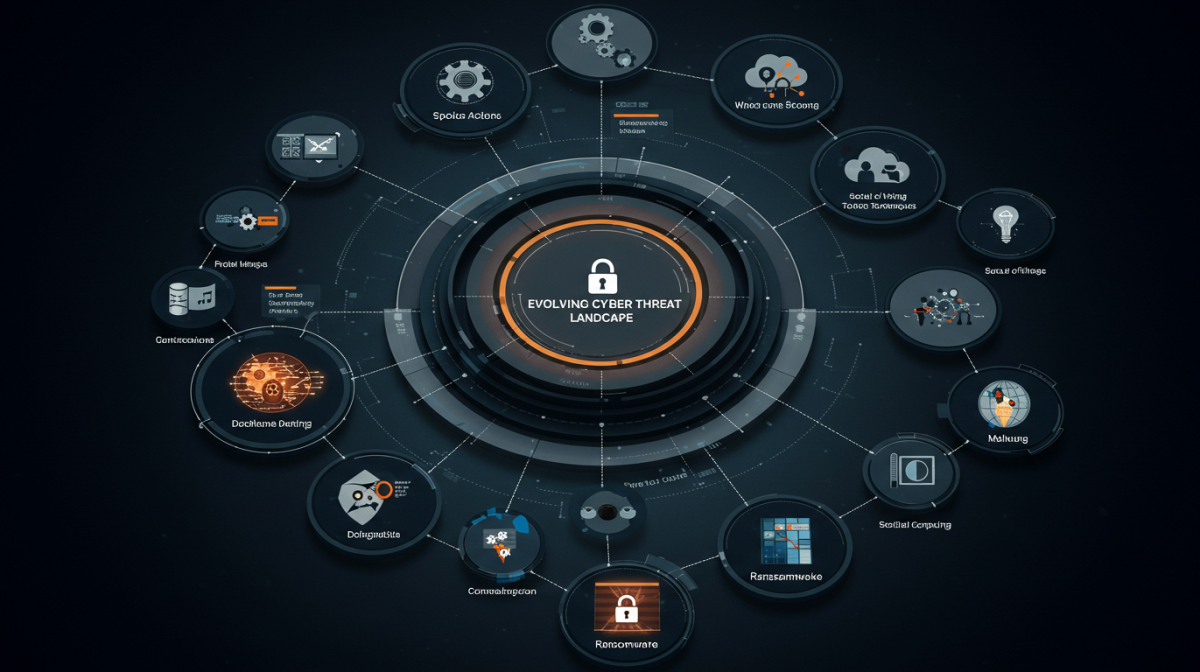
In today’s hyper-connected world, no organization is immune to the rising tide of digital risks. From AI-powered attacks and ransomware-as-a-service to insider breaches and supply chain exploits, modern cyber threat actors are more sophisticated, faster, and harder to detect than ever before. As businesses embrace digital transformation, they must also confront the evolving the modern cyber threat landscape where a single overlooked vulnerability can lead to devastating consequences. This guide dives deep into the most pressing cybersecurity threats organizations face today, offering expert insights, real-world data, and actionable strategies to stay ahead.
1. The Evolving Cyber Threat Landscape
1.1 AI-Driven and Automated Attacks
AI isn’t just in defense anymore; modern cyber threat actors use it too. According to Fortinet, automated AI-powered scans now reach ~36,000 per second, contributing to a 42% rise in credential-based attacks. They emphasize the urgent need for modern defenses like AI-enhanced detection, zero-trust, and real-time threat intelligence (webinars.on24.com, techradar.com).
Accenture also highlights in a recent survey that 90% of organizations aren’t prepared for AI-driven threats, with 36% stating AI is progressing faster than their defenses (axios.com).
1.2 Malware-Free Intrusions & Living-off-the-Land Techniques
CrowdStrike’s 2025 Global Threat Report reveals that 79% of detections were malware-free, “a modern-cyber-threat” posing stealthy and difficult-to-detect intrusions using legitimate tools often via credential harvesting, phishing, or social engineering (crowdstrike.com).
1.3 Ransomware and Ransomware-as-a-Service
Ransomware continues to dominate, with operations like LockBit 3.0, Play, Medusa, and Ransomhub operating RaaS models (techradar.com). These professionally run services offer turnkey solutions to criminals, fueling scalable and far-reaching attacks.
2. Major Attack Vectors
2.1 Phishing & Social Engineering
Still the top vector often amplified by AI‑crafted personalized messages. ConnectWise’s 2025 threat overview ranks phishing as a top 5 threat (connectwise.com). Research on tools like FraudGPT shows how purchase of AI‑generated lures dramatically raises impersonation sophistication (arxiv.org).
2.2 Credential Theft & Supply Chain Exploits
Fortinet’s 2025 report notes a 42% jump in stolen credentials, with RDP and edge systems as major entry points (fortinet.com). Meanwhile, supply‑chain attacks remain a top concern with governments mandating better vendor practices (e.g. NIST’s EO 14028, EU’s NIS2) .
2.3 Insider Threats
Malicious or negligent insiders pose serious risks. With internal access, attackers bypass perimeter defenses. The FBI highlights that insiders are often hardest to detect and contain (en.wikipedia.org).
2.4 IoT, Cloud & Legacy Software Vulnerabilities
Unpatched or outdated systems are an open door. A recent IEEE paper revealed 32% of cyberattacks exploit unpatched vulnerabilities (arxiv.org). Cloud-specific attacks and IoT-enabled botnets were cited in ON24 webinars and Fortinet’s 2025 forecast (webinars.on24.com).
2.5 Nation-State & Hacktivist Attacks
Geopolitical tensions escalate cyber warfare. Activities from Iran, China, Russia, North Korea including password spraying, DDoS, espionage target critical infrastructure (theaustralian.com.au).
2.6 AI Prompt Injection
Very new but growing: attackers manipulating LLMs (e.g., ChatGPT) to leak data or execute harmful commands. The Alan Turing Institute found 75% of enterprises use GenAI, but only 38% have defenses for prompt injection (en.wikipedia.org).
3. Expert Insights from ON24 Webinars
The ON24 webinar “What Cybersecurity Threats Do Organizations Face” outlines three pressing business risks:
- Adversaries: ranging from external threat actors to insiders.
- Critical Info: data like credentials, IP, and system configs are often primary targets.
- Business Risk: cyber incidents now directly threaten continuity and reputation (event.on24.com, comptia.org).
Another webinar on threat modeling (FAIR) emphasizes quantifying risk and applying structured risk-based frameworks .
4. Strategic Defense Strategies
4.1 Adopt Zero-Trust Architectures & Identity Security
With 90% of breaches credential-related, strict identity controls (MFA, federation security) and zero-trust models are essential .
4.2 Embrace AI-Driven Security
Organizations should mirror attackers deploying AI/ML-based monitoring for anomaly detection and threat hunting, as recommended by Fortinet and CrowdStrike .
4.3 Secure Supply Chains & Patch Management
Ensure vendor compliance per NIST EO 14028, NIS2, EU’s DORA, and regularly apply patches to mitigate known vulnerabilities (en.wikipedia.org).
4.4 Build Human Resilience
IBM reports 95% of breaches involve human error. Interactive phishing simulations, gamified training, and behavioral nudges are critical (en.wikipedia.org).
4.5 Plan for Quantum & Future Threats
Long-term: begin transitioning to post-quantum cryptography. Financial institutions must act before quantum computers break current encryption (arxiv.org).
4.6 Governance, Regulation & Risk Modeling
Quantify risk (e.g., via FAIR), align with ICS standards like IEC‑62443, and adopt global cybersecurity governance frameworks to meet legal duties .
5. Final Thoughts
The current cybersecurity environment is complex and accelerating. From stealthy AI-enhanced incursions to geopolitical cyber warfare and emerging threats like prompt injection and quantum decryption organizations must embrace:
- Agile defenses powered by AI/ML.
- Zero-trust and identity-centric controls.
- Continuous employee training and supply chain scrutiny.
- Future-proofing via quantum and governance preparedness.
As ON24 emphasizes: understanding your adversaries, protecting what matters most, modeling risk then executing will distinguish resilient organizations in an unpredictable landscape.
References & Further Reading
- ON24 Webinar: What Cybersecurity Threats Do Organizations Face…
- CrowdStrike 2025 Global Threat Report (crowdstrike.com)
- Fortinet Cybersecurity Forecast 2025 (cloud.google.com)
- ConnectWise: 10 Common Cybersecurity Threats (2025) (connectwise.com)
- Alan Turing Institute on Prompt Injection (en.wikipedia.org)
- ArXiv: Quantum & AI threats in finance (arxiv.org)
- ArXiv: Risks of outdated software (arxiv.org)
- Wikipedia: Insider threats (en.wikipedia.org)
- Wikipedia: Supply chain attacks (en.wikipedia.org)
- theaustralian.com.au
- axios.com
- techradar.com


